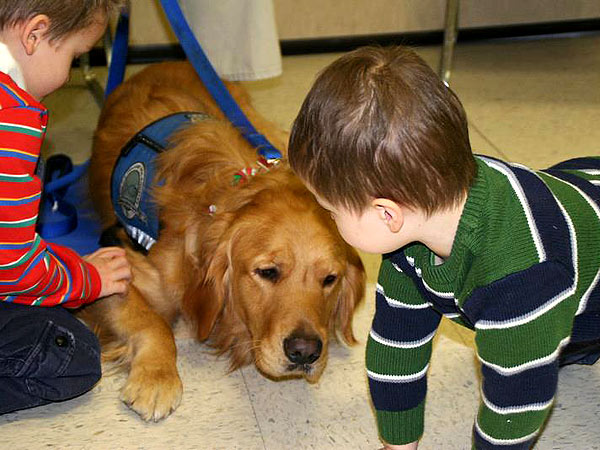
A private school that denied a child access with his service dog has agreed to pay the family a $35,000 settlement

The Learning Clinic, a private school in Connecticut that offers educational and clinical services through residential boarding and day school programs, agreed to pay a child’s family a $35,000 settlement after the school had denied a child access with his service dog.

The school also agreed to train its employees and adopt new policies to ensure compliance with the provisions of the Americans with Disabilities Act, the U.S. Attorney’s Office in Connecticut said in a news release.

The child’s parents had reported that the school discriminated against the student by failing to provide accommodation so that the child could attend school and live on campus with his service dog, the release said.

We often receive “hate mail” from irate people who criticize service animal laws!

This is a very sad truth. Here at SARC, we often receive “hate mail” from irate people who criticize service animal laws and call some of the owners fake or frauds!

Hard to believe, but there are people who would rather see the rights of the disabled reduced, in order to control the few “fake” owners of “fraudulent” service animals.

Here are some of the recent emails, with the author names removed to protect privacy:

“For the most part I support the regs regarding service dogs. However, because there is so much abuse occurring regarding Emotional Support Animals and the disregard to train the dogs properly, I feel the requirements are too lenient. I believe that these service animals, emotional or otherwise, should receive strict training and be confirmed as passing all tests. In addition, I disagree that they should not be required to wear a vest or other accessory to designate status — AND should only be available to those who successfully pass the program. I want to state that I don’t think the general public should be required to pay for the training or the accessory, but the owner should absorb all costs. There is too much abuse going on and when there are people who are offended by dogs, fear them, or their allergies act up when dogs are around — you must impose restrictions and requirements. It’s not a free for all because an owner can’t bear to go anywhere without their dog. I love dogs and animals in general. I have family and friends who do not like them or are afraid of them — and have many who love them like I do. But to impose a “service dog” or “emotional support animal” on everyone without credible credentials is beyond me.”

RESPONSE: Really? “Strict” training? Passing “all tests”? And what if the owner cannot find a “strict” trainer or test center nearby? Is he or she out of luck? Who defines what constitutes such training and tests? Whose tax dollars do you want to pay for such training or testing centers? Or do you want the owner to pick up that tab? Actually, you answered that question— “the owner should be required to absorb all costs.” Oh, and you want such animals to be required to wear a special vest? You mean, that the disabled should be required to publicly display their status to the world at large? You didn’t mention it, but do you want the owner to also wear a placard around their neck? To tattoo their status on their face? Outrageous.

Here’s another one:

“It is unfortunate that more and more often I see people label their dogs service dogs when in fact the people are “scamming” the system. I work in a [government building] and observe people using their pets labeled as service dogs so they can take them in to [government building]. Sometimes these are unfriendly dogs. [Government] staff has no recourse but to allow them to go in because the dogs are wearing the labeled vests. I think that you should have strict criteria, e.g. demanding that you see some certification that the person is mentally or physically disabled, so that you help avoid this problem.”

RESPONSE: So are you some sort of expert who can spot the “fakes”? You seem pretty sure of your “fake” spotting abilities. Have you considered that those service animals are actually legitimate? And do you really want to require that disabled persons get themselves “certified” as mentally or physically disabled and that they be forced to present such paperwork at anyone’s arbitrary demand? Ludicrous.

The accusations and blanket statements are shocking, and the obvious bias against the disabled is blatant. Whether these people realize it or not, they are advocating to make life more difficult for legitimately disabled persons and their service animals and emotional support animals.

Does abuse ever occur? Maybe. Probably. Just like there are probably people out there who have fake placards for parking in disabled parking spaces, or people who enroll in welfare who don’t actually meet the guidelines, or people who ask for a senior discount at a movie theater when they are actually not yet 55 years old. Yes, there are cheaters in the world. People who speed their cars over the posted limits, people who cut in line, people who abuse rules or systems. People who cheat on taxes.

Is that any reason to take away or lessen the rights of the disabled? To make it harder for them to enforce or exercise their rights? To demand that they jump through difficult administrative hoops in an attempt to curb abuse or “fakes”?

Keep in mind that abusers will find a way to abuse the system no matter how many checks, balances, red tape, or hoops you create. So by making life harder for the disabled, you help no one, and hurt those who most need our support. And any “fakers” would still find a way. So shame on anyone who broadcasts such “hate mail” messages and is willfully blind to what’s really at stake— access and equality for all under law!

To loyal readers: Thank you for supporting SARC! And please register your Service Animals and Emotional Support Animals, which is optional under law, to show your support for the education of the public about these critical issues.

Restaurant slapped with penalties after asking woman and her service dog to leave

Restaurant asks woman, service dog to leave

ALBUQUERQUE, NM – A downtown restaurant is slapped with penalties after asking a woman to leave because she had her service dog with her.

A settlement between Maloney’s Tavern and the U.S. Attorney’s office comes months after the woman was refused service. In August, Susan Cash and her friend went to Maloney’s Tavern in downtown.

Cash has Multiple Sclerosis and was accompanied by her service dog. A settlement between Maloney’s Tavern and the U.S. Attorney’s office says after she told employees that her dog was a service dog, they not only refused service – they told her to get out.

“The bartender and other customers at the bar made comments about having lost table space for a wheelchair ramp and made jokes about Ms. Cash have a dog to take care of her,” the settlement says.

“The bartender insisted that Ms. Cash eat outside or leave the restaurant.”

The US Attorney’s office investigated, and decided the restaurant violated the American’s with Disabilities Act.

Neither the restaurant nor it’s parent company, Ms.Cash or her lawyer would comment on the case. As part of the settlement, Maloney’s had to pay a $2500 fine and post a sign saying they welcome customers with service animals. They also have to train employees on the provisions of the ADA.

“I think most business owners genuinely want to do the right thing and sometimes there confusion about what constitutes a service animal,” said Gred Trapp, director of the Commission for the Blind. “It’s that confusion that causes problems.”

Service animals perform specific task for a people with disabilities. Under state and federal law, it’s their right to have them anywhere the public is allowed. “Folks in general don’t really have a grasp on utilization of service animals,” said Jim Parker, director for the Governor’s Commission on Disabiltiy. “People expect cards or certification and it doesn’t exist.”

Parker says they get calls almost every day from people whose service dogs were denied or questioned. He says that if a collar or certification was required for service dogs, it might clear up some of the confusion. “They don’t understand this dog provides a real, ongoing every day service – everything from picking up your keys if you drop them to guiding you down the street,” he said. The Americans with Disabilities Act has been in effect for more than two decades.

People with disabilities and the proposed 2013-14 budget: No cuts = first good news in years

SACRAMENTO, Calif., Jan. 10, 2013 – People with disabilities, including seniors, received some good news in today’s proposed state budget, after years as targets of state budget cuts which drastically reduced already-low incomes and crucial services.

“We are relieved that the overall fiscal picture has brightened, and that the governor proposes sunsets to some of the prior cuts,” said Catherine Blakemore, executive director of Disability Rights California.  “We would like to see restoration of the cuts to Medi-Cal and SSI, as well as In Home Supportive Services (IHSS), and hope the legislature considers that.”

The good news:

Department of Developmental Services:  No new reductions in regional center budgets; the 1.25% rate reduction to community providers of services will end on June 30, 2013; some limited reimbursement of private insurance co-pays for behavioral services will be allowed.

IHSS: Current 3.6% cut will end on June 30 (but the proposed 20% and another major cut are still pending the outcome of legal challenges).  IHSS provides low-cost services to approximately 420,000 seniors and persons with disabilities, enabling them to stay in their homes safely and avoid institutionalization.

SSI: The monthly cash benefit for extremely low-income Californians who are aged, blind or disabled will increase by $20 and $30 for individuals and couples, respectively, in 2013 and 2014.  Current monthly grant levels are $854 for individuals and $1,444 for couples.

Coordinated Care Initiative (CCI):  The budget moves implementation from June to September and includes a phase-in for these major changes in medical and long term care for around 850,000 low-income Californians. The CCI does two things:  moves approximately 560,000 people who have Medicare and Medi-Cal (“dual eligibles”) into managed care in eight counties; and changes the way another 310,000 seniors and persons with disabilities, already in Medi-Cal managed care, receive long term care services in those same eight counties.  DRC thinks that the state should reduce the number of counties involved and slow down the significant shift to managed care.  We saw problems in previous transitions and have serious concerns about whether the state and the managed care plans are ready to meet the needs of this population.  We also believe the state should include more critical long term care services in the benefit package.

Medi-Cal expansion to people who earn up to 138% of federal poverty level.  Part of the federal Affordable Care Act (ACA), coverage would be comparable to existing Medi-Cal but would exclude long term care. (People with disabilities could be eligible for long term care if a disability determination is made.)  The budget proposes two potential avenues to achieve this expansion; one through existing county Low Income Health Plans (LIHPs), the other would be administered by the state.

The bad news:

Courts:  Additional cuts to the courts affect access to justice for people with disabilities. Courts have already reduced their hours, eliminated small claims court and self-help centers.

Medi-Cal enrollment lock-in:  the proposed lock-in allows only yearly open enrollment.  People with disabilities often have complex and ever-changing medical needs requiring flexibility that a lock-in eliminates.

Airlines forced family to leave their dog behind because of 2″ technicality!

All Hospital Corpsman First Class John Gromer wants is his dog back. When he and his family were relocated to Japan by the Navy back in November their one-year-old dog Gunner got left behind at the airport when the airline told the Gromer family that Gunner’s kennel was two inches too big to load onto the plane.

On November 29th the Gromer family was making the trip to Japan and was planning to bring their dog Gromer with them. That’s when they were told by American Airline that Gunner’s kennel was two inches too big to be put on the plane. John Gromer’s children started crying at the thought of having to leave Gunner behind. To make matters worse Gromer says the ticket agent was rude to the family yelling at them, “Sir, your dog can’t go. Now get him off my scale.”

Gromer had brought the large kennel because he was trying to comply with guidelines stated on the airline’s website that the dog have enough room in the crate to be comfortable. Gromer had given American Airlines the size and the weight of the kennel prior to the flight when he made the reservation and the airline made no objection at that point.  Repeated requests for a statement or answer from the airline by both the press and Gromer have gone unanswered.

Gunner has been staying with a family friend in San Diego. It was originally going to cost the family $175 to have Gunner flown over with them. Gromer has now been told that it will cost nearly $4,000 to fly Gunner to Japan on a cargo plane.

Gromer is frustrated that he was treated so disrespectfully by the airline but most importantly he wants to be reunited with his dog. “I had to walk away in the airport, leaving my dog basically stranded and alone in the airport so I could make my flight,” said Gromer. “All I want is my dog back.”

Because Gunner is not a Service Dog, he must ride in the cargo hold rather than with his handler. Most owners of Service Dogs will not face the issue faced by the Gromer family, but this story is a reminder that airlines do sometimes get very particular about technicalities and details when it comes to allowing animals on board of airplanes.

Trained dogs help children in Newtown, Connecticut, cope with the shooting tragedy

The Newtown, Conn., tragedy has put some specially trained dogs on the case. Five golden retrievers and eight handlers worked to comfort children and adults affected by the school shooting tragedy.

They have been on the case in the community by giving comfort to children and adults with physical affection in the form of cuddles, licks and nuzzles after making their working journey to Connecticut.

Some of the children comforted by the dogs give their first smiles since the shooting. The dogs bring back a sense of peace that many people could not feel since the tragedy.
They are helping some of the burden of grief drop off a bit.

The comfort dogs are trained not to bark and to be canine good citizens. They help to relieve the pain in a way that only dogs can. Dogs have the amazing ability to zero in on the person in front of them that has the greatest need. They can have six or seven people sitting there, yet they go to the one who has the greatest loss. The dogs just know.

While it is the children who have benefitted the most from canine comfort, adults are also quietly availing themselves to the service of the comfort dogs.

To learn more about the Lutheran Church Charities’s K-9 Parish Comfort Dogs program, click here.

Photo: Courtesy of K-9 Parish Comfort Dogs

An under 10-pound Chihuahua trained and licensed as a service dog for asthmatic children

When thinking of service dogs, large breed dogs, like the German Shepherd, usually come to mind. Who would imagine that an under 10-pound Chihuahua would be trained and licensed as a service dog for asthmatic children?

Missouri Western nursing student Katelynn Crawford is the owner and trainer of the tiny Dexter. Crawford’s entire family believes in animal therapy, and they believe pets, specifically dogs, can be very therapeutic.

Dexter, a full-blooded Chihuahua, is one-and-a-half years old. Dexter has spent approximately half his life (nine months) in training to be a therapeutic source to mentally handicapped children who suffer from asthma and other breathing disorders.

“Dexter, and other dogs like him, can be a huge source of comfort and therapy to someone who suffers from asthma,” Crawford said. “He has trained with my mother, Shirley Catlett, at Savannah Middle School learning life skills with the children.”

Dexter is specifically trained to help regulate the breathing of a person having an asthma attack. By lying on a person’s chest and breathing with the person, the person’s natural body response is to relax its breathing, as Dexter relaxes his. Dexter is not a magical dog, he cannot save a life by performing CPR, but he can be a source of therapy in regulation of someone’s breathing.

Stolen Service Animal Returned Safely to Owner!

Lola, a 4-year-old Yorkshire Terrier, was stolen around 3 p.m. on November 19, 2012, from Robert Runkle, who had parked his car in San Francisco, CA.

The thief broke the side window of his car and took Lola while leaving behind Lola’s collar and dog tags.

Lola is a service animal who provides companionship to Runkle as he undergoes dialysis for kidney disease and chemotherapy for lymphoma.

“He’s devastated,” is how Runkle’s neighbor describes his distress.

A neighbor offered a $3,000 reward for information leading to Lola’s safe return. “Just say you found it at a park and bring it to San Francisco Animal Care and Control,” the neighbor said.

There is a happy ending to this story. Runkle was reunited with Lola when an unidentified Oakland woman contacted them to say she found a Yorkie roaming around Lake Merritt that might fit Lola’s description.

Sure enough, that dog was Lola. The dog was reunited with Runkle, just in time for the holidays!

Christine Mott speaks out about service animals in rental housing

The new chairwoman of the animal-law committee of the New York City Bar Association, Christine Mott heads a group that plays a key role in determining how animals fare in New Yorkers’ homes and beyond. She recently spoke out about the issue of service animals in rental housing:

“A major issue involves service animals. And not just Seeing Eye dogs for the blind. People might also need a service animal because of physical impairments that involve hearing or mobility, or for epilepsy or asthma, as well as psychological conditions like post-traumatic stress disorder or depression. Federal law says that a person can have a service animal if it’s medically necessary. We want to make sure that law is enforced. For example, we supported legislation to make it clear that landlords cannot require proof that a service animal has been certified by the state.”

Autistic Boy Patiently Waiting for Service Dog Puppy to Complete Its Training

16-year-old Nate Weldon has autism, and his black Lab, Maggie, is a service dog, specially trained to serve, assist and even calm Nate when his autism interferes with his ability to control his moods.

Nate’s mother, Jodi Weldon, says, “[W]hen something’s bothering him, he’ll seek [Maggie] out.”

The Weldons are waiting for another service dog for their other son, Zachary, who is 14 years old and also autistic. They hope to receive Remi, a 5-month-old English Lab puppy, after she is properly trained. Rebecca Rodock is raising a Remi until Remi becomes a Service Dog. Ms. Rodock is a volunteer puppy raiser for Perfect Fit Canines Inc., a company that provides service dogs to help disabled individuals.

Read more: http://old.post-gazette.com/pg/12299/1271593-56.stm#ixzz2BU97dRn6