Is an individual allowed to have multiple assistance animals such as two service animals?

Multiple Assistance Animals

There is no specific regulation or law that limits a disabled owner to a certain number of Assistance Animals. Because there is no direct guidance, it is likely that an owner would have to show a reasonable need for the number of animals in question.

For example, if a disabled owner/handler has diabetes and mobility issues, and keeps two Service Animals because one animal is trained to detect a drop in blood sugar, and the other is trained to provide physical support and stability, and to fetch objects and open doors, then it would probably be deemed reasonable to have both animals.

However, if a tenant keeps two Emotional Support Animals to assist with combating suicidal tendencies and severe depression, then the landlord could have a viable argument against allowing both animals unless there was a reasonable justification for needing both animals.

The landlord could argue that one animal alone would provide the needed support. A physician’s note would likely need to specifically recommend the multiple animals.

Are you an owner of an assistance animal?

The Service Animal Registry of California invites you to have your assistance animal registered in order to designate its status. We also encourage you to take our online classes so you can be fully aware of your rights and gain more knowledge about your support animal.

Finally, we present to you our book entitled, “ASSISTANCE ANIMAL LAWS: LEARN YOUR RIGHTS REGARDING SERVICE ANIMALS, EMOTIONAL SUPPORT ANIMALS, THERAPY PETS, AND OTHER DOGS, CATS, AND ASSISTANCE ANIMALS” to provide you with a complete education on assistance animals.

Purchase your copy of the book by clicking the text or image below.

ASSISTANCE ANIMAL LAWS: LEARN YOUR RIGHTS REGARDING SERVICE ANIMALS, EMOTIONAL SUPPORT ANIMALS, THERAPY PETS, AND OTHER DOGS, CATS, AND ASSISTANCE ANIMALS

Assistance Animal Laws Book

What are the five things you need to know about Service Animals?

Service animal

Some people rely on service animals to provide them with daily support for specific medical conditions. If you don’t own a service animal, you may have some questions about what these animals do and whether they are allowed in the synagogue (Jewish place of worship).

Below are five common questions about service animals and their corresponding answers.

1. What is the definition of a service animal?

A service animal is an animal (usually a dog) that’s specially trained to help a person with a disability perform tasks that he cannot do himself. A common scenario is a blind man assisted by a trained service dog.

2. What is the role of a service animal?

Service animals can take on different roles and that includes detecting abnormal blood sugar levels (for diabetics), alerting people with hearing problems, picking up items for those with mobility problems, and more.

3. Is a service animal allowed in the synagogue?

Though the ADA states that service animals are allowed to accompany their owners in public spaces, synagogues are not covered under the ADA. This means that a service animal is not permitted in the synagogue unless there is an event that’s open to the public.

4. Can you feed and pet another person’s service animal?

Whether another person’s service animal wears a vest or not, you always need to ask permission from the owner before touching or speaking to the animal. Remember that a service animal is not considered a pet and is obligated to its owner.

5. What if you encounter a disruptive service animal?

A service animal should be well-behaved and obedient to its owner’s commands. If the animal disrupts others by barking or wandering around and the owner does not do anything about it, you may request for the animal to be removed.

Article source: Chabad.org

Are you an owner of an assistance animal?

The Service Animal Registry of California invites you to have your assistance animal registered in order to designate its status. We also encourage you to take our online classes so you can be fully aware of your rights and gain more knowledge about your support animal.

Finally, we present to you our book entitled, “ASSISTANCE ANIMAL LAWS: LEARN YOUR RIGHTS REGARDING SERVICE ANIMALS, EMOTIONAL SUPPORT ANIMALS, THERAPY PETS, AND OTHER DOGS, CATS, AND ASSISTANCE ANIMALS” to provide you with a complete education on assistance animals.

Purchase your copy of the book by clicking the text or image below.

ASSISTANCE ANIMAL LAWS: LEARN YOUR RIGHTS REGARDING SERVICE ANIMALS, EMOTIONAL SUPPORT ANIMALS, THERAPY PETS, AND OTHER DOGS, CATS, AND ASSISTANCE ANIMALS

Assistance_animal_laws_6 (1)

New Yorker’s new humor series, “Shorts & Murmurs,” disparages the mentally ill and emotional support animals

Making fun of people with mental illness, should be strictly verboten, as it only adds to their stigmatized status.

Sadly, The New Yorker’s new humor series, “Shorts & Murmurs,” is a shameful attempt to create humor at the expense of an already abused social group.

In the first video, titled “Pets Allowed,” inspired by a similarly silly article by Patricia Marx published last year, The New Yorker writer Marc Philippe Eskenazi tours New York with a series of assistance animals intended to appear absurd, beginning with a pig and touching on a turkey, before proceeding to a llama.

This is blatantly an act of making “fun” of (and trying to shame) people with disabilities who require assistance animals in order to enjoy the everyday activities of life. 

The reactions of most New Yorkers he comes across are captured on film by video camera. Eskenazi shows bystanders a letter from a therapist (obtained online) which he presents whenever he is questioned. His demeanor is clearly mocking those who have assistance animals.

The New Yorker will soon be reminded, we live in an age where mocking the disabled is not only frowned upon, but appalling and morally bankrupt..

Some commentators are already noting the problem with this piece: “No thanks Patricia Marx for this article. You and The New Yorker just contributed to the negative stigma of mental illness. This mocks anyone actually benefiting from an ESA. This article encourages people who are on the fence to seek help with a disorder to not seek help. The next time there is an act of violence committed from someone with a mental illness … Think about this article of mocking and bullying that you have written and published…and consider that you might have contributed to it. Perhaps you should write an article that shows the benefits of an ESA.”


‘Amazing’: Service dog helps 11-year-old girl with rare disorder walk

‘Amazing’: Service dog helps 11-year-old girl with rare disorder walk

Courtesy Burton family

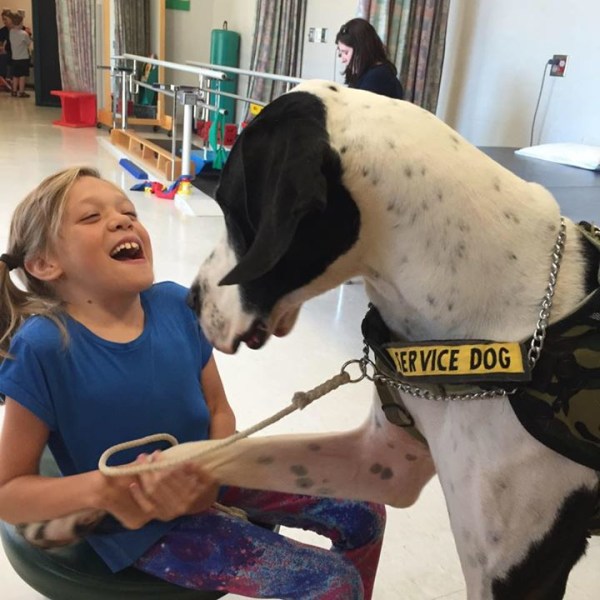
Bella Burton, 11, gets a kiss from George, her service dog.

She’s made so much progress, the family was recently astonished to see her dash and frolic in the grass as her big furry protector looked on.

“I don’t remember the last time I watched my child run through the yard,” Rachel Burton, Bella’s mom, told TODAY. “Seeing her just run was amazing to us.”

The Burtons, who live in Woburn, Massachusetts, will travel to Orlando, Florida, next month where George will be honored by the American Kennel Club for his impact on the family.

Courtesy Burton family

Bella and George share a light moment.

It’s been a long road for Bella and her loved ones.

When the girl was 2, her parents noticed she wasn’t keeping up on her growth curve. The problem stumped her doctor, who suggested genetic testing to find out what was wrong. The tests revealed she had Morquio syndrome, a progressive disorder in which the body doesn’t produce enough of a key enzyme. That leads to a buildup of sugar molecules, which can cause problems with bone development and growth.

It’s estimated the syndrome occurs in only 1 of every 200,000 births.

Courtesy Burton family

George accompanies Bella to her medical appointments.

In her young life so far, Bella has had nine major surgeries, including reconstruction of her hips and feet. She’s also had problems with mobility, getting around on crutches but using them more to swing her legs rather than walking on them. Her parents worried she was losing muscle strength in her lower body, relying on her upper body instead to move.

That all changed when she met George.

The Burtons weren’t looking for a service animal, but about two years ago, they heard about theService Dog Project in Ipswich, Massachusetts, which trains and donates Great Danes for people with balance and mobility issues.

Courtesy Burton family

Standing tall, with George’s support.

With its impressive height and heft, a good temperament and easygoing lifestyle, the breed is perfect for the job, the non-profit explains.

Most dogs are paired with adults, but when the family began visiting, it was clear the girl was ready for a canine companion.

“Once we saw Bella being around those dogs, how she was always in such a great mood and she loved going there, we thought, ‘What are we waiting for?'” Burton recalled.

“When she was visiting George and he didn’t want her to leave his kennel, they were like, let’s try them.”

Courtesy Burton family

George is now 2 years old and weighs 131 pounds.

The Burtons brought him home just for the weekend over several weeks at first, then permanently added George to the family in January. They’re grateful the fully trained animal was donated by the Service Dog Project.

Bella weighs 44 pounds and stands 43 inches tall. Soon, she put away the crutches and began to walk, with the help of her furry 131-pound friend. With her height, the dog’s back is right by her armpit, providing lots of stability.

Courtesy Burton family

Bella leans on George for support.

“She leans on him for support like she would if she used one crutch. But it’s much more exciting when it’s a dog than a crutch,” Burton said.

George now goes everywhere Bella goes. He spends the day with her at school, where he walks her from class to class and patiently lies in a bed right next to her desk. He doesn’t bark or demand to go outside, Burton said. The other kids are used to his presence and know they can’t pet him because he’s there to work.

George is also a comfort during Bella’s medical appointments, including a weekly six-hour infusion of a medicine that gives her more energy.

“At first, he did not like it when she would get her IV put in. He would want to get up and protect her. But then he realized it had to be done,” Burton said.

At night, he climbs into bed with the little girl, often sleeping beside her.

Courtesy Burton family

Bedtime for Bella and George.

Bella’s prognosis is hard to predict, her mom said. Some people with Morquio syndrome have lived to 20, others are in their 40s and still fine. Bella continues to see specialists who monitor her for issues related to the disorder.

Each time, George is there.

“He’s totally a member of the family now,” Burton said.

Follow A. Pawlowski on Google+ and Twitter.

How to Sue if a Business or Landlord Discriminates Against You Because of Your Service Animal, Assistance Animal, or Emotional Support Animal

How to Sue in Small Claims Court if a Business or Landlord Discriminates Against You Because of Your Service Animal, Assistance Animal, or Emotional Support Animal

Why Use Small Claims Court to Sue for Discrimination?

If a private business or landlord discriminates against you because of your disability, you can sue them in federal court or state court or you can file an administrative claim with a federal or state agency. But, if your claim is for $10,000 or less, you can sue in small claims court yourself, without necessarily needing an attorney. The small claims process is quick and cheap. The rules are simple and informal. And, you don’t need a lawyer.

Which Laws Protect Me?

If a business open to the general public, like a restaurant, library, movie theater, hotel or medical office, discriminates against you because of your disability, you can sue them. A federal law called the American with Disabilities Act (ADA) protects you in every state of the U.S.A., as well as state laws and even local county and city municipal codes in some places.

What are the California laws?

There are three main California laws that protect you:

– Section 51 of the California Civil Code (the Unruh Civil Rights Act) protects you if a business treats you worse than it treats others without disabilities. Cal. Civ. Code § 51, et seq.

– Section 54.1 of the California Civil Code protects you if a business makes it hard for you to enter or get around a public area (like an inaccessible door or restroom). This section also protects you if a business stops you from using goods or services because of your disability. For example: not letting you use your service animal, or, does not give you the same service  other customers would get. This section also does not allow landlords and other housing providers to discriminate against you based on your disability. Cal. Civ. Code § 54.1 “

– The Fair Employment and Housing Act (FEHA), makes it unlawful for any housing owner to discriminate against or harass any person because of their race, color, religion, sex, sexual orientation, national origin, ancestry, familial status, source of income, or disability.  Cal. Gov’t Code § 12955

You can sue a business or other organization open to the public, or a housing provider (or their employee) for breaking these laws.

What are the federal laws?

The ADA, specifically Title III, does not allow businesses open to the public (such as restaurants, hotels, grocery stores, retail stores, and privately owned transportation systems) to discriminate against you based on your disability. Title III of the ADA also requires that these businesses be accessible to people with disabilities. 42 U.S.C. §12182. Title II of the ADA has similar requirement for state and local government services and facilities.  42 U.S.C. §12131, et seq.

The Fair Housing Act (FHA) protects against discrimination in renting and buying a house.See 42 U.S.C. § 3604(f). The FHA states that discrimination includes a refusal to make reasonable accommodation to rules, practices or procedures when necessary to afford a person with a disability equal opportunity to use and enjoy the dwelling.42 U.S.C. § 3604(f)(3)(B). Similarly, the FHA requires landlords to permit reasonable modifications of the premises and of the rules (when needed to afford such equal opportunity to use and enjoy the dwelling). 42 U.S.C. § 3604(f)(3)(A)

What if a California business violates the Americans with Disabilities Act (ADA)?

California law allows you to sue for an ADA violation even though ADA is a federal law. Cal. Civil Code § 54.1. A business violates the ADA if it:

– does not give you equal and full use of its goods, services, facilities, and privileges; or – makes you use separate or different facilities (unless they do this to make sure you get the same goods and services as offered to others); or

– uses contractors or employees who discriminate against you because of your disability.

For more information on the ADA, visit the U.S. Department of Justice’s website dedicated to the ADA (www.ada.gov)

What does California law consider a “disability”?

California law protects people from discrimination due to an actual or perceived physical or mental impairment that makes achieving a major a life activity difficult.Cal. Gov’t Code § 12926(i) and (k). This includes physical and mental impairments, such as, but not limited to: chronic or episodic conditions such as HIV/AIDS, hepatitis, epilepsy, seizure disorder, diabetes, clinical depression, bipolar disorder, multiple sclerosis, and heart disease.

Is the business required to make an accommodation that I need because of my disability?

Maybe. The ADA says businesses may have to give you help, provide some device or technology, remove barriers, provide qualified sign language interpreters, or make a change in the way it operates so you can have equal access to its goods and services. But the law says these aids and adjustments must not be too expensive for the business based on the assets of the business and possibly the parent company. or change the basic nature of the business. 28 C.F.R. §36.104. However, such situations are likely rare. The business also may not have to provide reasonable accommodations if the person requesting the accommodation poses a direct threat to the health or safety of others that cannot be eliminated or reduced by providing reasonable accommodations. 42 U.S.C. § 12182(b)(2)(A)(ii) and (iii), Cal. Civ. Code § 51, et seq.

Can I sue any California business?

Yes. You can sue “any business establishment whatsoever.”Cal. Civil Code § 51(b). This means any business that is open to the public, including, for example: Restaurants, stores, theaters, ATM’s, gas stations – Hospitals, clinics, and doctors’ offices and lawyers’ offices – Planes, trains, buses, and cruise ships (airplanes have different laws that apply) – Private schools, adoption agencies, and businesses offering telephone, TDD and TTY connections – Health clubs, amusement parks or resorts. – Hotels, inn, motel, or other place of lodging (unless there are less than five rooms for rent and the owner lives there) You cannot sue businesses like purely private clubs or religious organizations.28 C.F.R. §36.104

However, just because a club has membership requirements, does not necessarily make it a private club under the law. Generally, to be exempt from the ADA the club has to be a non-profit, open only to members and their guests and cannot host public events, such as tournaments, community affairs or political fundraisers.

[Small Claims Guide]

HUD announced today it is charging landlords of high-rise in New York with violating the Fair Housing Act by refusing emotional support animal

The U.S. Department of Housing and Urban Development (HUD) announced today that it is charging the owners and landlords of a high-rise complex in New York City with violating the Fair Housing Act by refusing to allow a resident with disabilities to have an emotional support animal.

HUD’s charge alleges that Friedman Residence, LLC (formerly called the Aurora), Common Ground Management Corporation, and The Actors’ Fund of America refused to accept that the resident required a dog to cope with the symptoms of his disability.  Read HUD’s charge.

The Fair Housing Act requires housing providers to make reasonable accommodations in policies or practices when a person with a disability requires such accommodations, including granting waivers to “no-pet” policies for persons who require assistance or support animals.

Additionally, the law makes it unlawful to make housing unavailable to any person because of a disability.

“It’s not a landlord’s role to determine what a resident with disabilities needs in order to perform life’s daily functions,” said Gustavo Velasquez, HUD Assistant Secretary for Fair Housing and Equal Opportunity.

“Landlords have an obligation to grant reasonable accommodations when they are needed and HUD will continue to work to ensure that they meet that obligation.”

The case came to HUD’s attention after the resident, who has a psychiatric disability, filed a complaint with HUD alleging that his right to have an emotional support animal was denied.

The man lives in a two-bedroom apartment at The Dorothy Ross Friedman Residence, a 30-story supportive housing residence for senior citizens, working professionals and persons living with HIV/AIDS that is sponsored by the Actors’ Fund, a New York nonprofit for performing arts and entertainment professionals. When the tenant moved into Friedman Residence in 2004 he did not have a support animal.

However, in 2010 the resident began being treated by a licensed clinical psychologist and a year later bought a small dog. After recognizing an improvement in the man’s condition, his doctor recommended that he register the animal as an official emotional support animal. In February 2013, the landlords initiated eviction procedures against the man due to the presence of the dog.

The man subsequently provided the property management director with documents from his doctor and the National Service Animal Registry showing that the dog was an emotional support animal, but instead of accepting the documentation, the landlords sent the man a final “Notice of Termination,” stating that he had not sufficiently demonstrated his need for the animal.

Legal proceedings between the resident and the landlords in New York County Civil Court were stayed while this charge was investigated. HUD’s charge will be heard by a United States Administrative Law Judge unless any party to the charge elects to have the case heard in federal district court.

If an administrative law judge finds after a hearing that discrimination has occurred, he may award damages to the man for the harm caused him by the discrimination. The judge may also order injunctive relief and other equitable relief, as well as payment of attorney fees. In addition, the judge may impose fines to vindicate the public interest.

If the matter is decided in federal court, the judge may also award punitive damages. In FY 2014, disability was the most common basis of complaints filed with HUD and its partner agencies, being cited as a basis for 4,606 complaints, or 54 percent of the overall total. Read HUD’s notice regarding service or companion animals.

Persons who believe they have experienced discrimination may file a complaint by contacting HUD’s Office of Fair Housing and Equal Opportunity at (800) 669-9777 (voice) or (800) 927-9275 (TTY).

Housing discrimination complaints may also be filed by going to www.hud.gov/fairhousing, or by downloading HUD’s free housing discrimination mobile application, which can be accessed through Apple devices, such as the iPhone, iPad, and iPod Touch.

Support animals bring the comfort of homes to dorms

At Miami University, some students have a different kind of roommate:  one that has a wet nose, a wagging tail and is always happy to see you.

Miami does not allow pets in residence halls, but some students this year are sharing their dorm rooms with an Emotional Support Animal, or ESA.

An ESA is an animal that helps to alleviate or lessen symptoms for a student with a mental or psychiatric disability, like anxiety or depression, as determined by a doctor or other medical professional.

Miami’s policy for admitting ESAs to residence halls states that the animals will be approved if “the student-owner clearly demonstrates the ESA is necessary to provide the student with an equal opportunity to use and enjoy the residence hall.”

According to Director of Student Disability Services Andrew Zeisler, there are currently eight ESAs living in Miami’s residence halls, including dogs, cats and a bearded dragon.

First-year Vivien Fierberg lives with her ESA, Cleo, to help with anxiety.  Cleo is a bearded dragon — a medium-sized lizard whose throat puffs out when it feels threatened, giving it its “beard.”

“I grew up on a farm, so I’ve always been around animals,” Fierberg said.  “When I decided to come here, it was important to me that I would be able to go back after school and still have an animal to hang out with.”

For Cleo to be permitted in the residence hall, Fierberg had to follow the process laid out by Student Disability Services.  A student who wants to register an ESA must provide written documentation from a healthcare professional, stating the student has a need for treatment of a mental or psychiatric disability and establishing the connection between that disability and the support the animal provides.

The student also has to provide a registration form and veterinary records for the animal.  After that, the student signs a policy that states they will pay for any damages or pest infestations the animal causes.

REST OF ARTICLE AT: http://miamistudent.net/?p=17012041

Invisible Disabilities: When is a dog a service dog? It can be hard to tell

Some have “no pet” policies, but if you walk in and see a person with a dog, don’t judge. The dog, like Jessica Hanaghan’s dog Noble, may be working.

The Americans with Disabilities Act (ADA) defines a service animal as a dog (or a miniature horse) that has been specifically trained to do work or perform tasks for an individual with a physical or mental disability. The tasks performed by the dog must be directly related to the person’s disability.

According to the ADA, businesses that serve the public must allow service animals to accompany people with disabilities where the public is normally allowed to go despite any “no pets” policy. A person with a service dog may be asked to leave only if the dog misbehaves or is a danger.

Under California Penal Code 365.5, a business that interferes with a disabled person’s right to have a service dog with them in public places can be fined up to $2,500.

When California resident Jessica Hanaghan was diagnosed with an incurable auto-immune disorder back in 2013, she knew her life was going to be challenging and different, but she never imagined a service animal would be such as resourceful addition to her life.

Her condition causes pain and swelling of her joints, which results in muscle pain and body tremors (called flares). Flares weaken her body, making it difficult to walk or even pick up items.

“There is no treatment for my disorder, so I have to learn to cope with this for the rest of my life,” Hanaghan said. “When I was diagnosed, I began researching alternative treatments, and I started reading about service dogs. I talked about it with my doctor, who supported the idea and said she’d give me the recommendations I’d need to pursue getting a service dog.”


Noble, a 2-year-old Field Golden Retriever, was trained specifically to work with Hanaghan. Noble assits with:

  • Basic tasks such as picking up dropped items,
  • helping her keep balance as she walks,
  • pushing buttons to open automated doors, and
  • recognizing when Hanaghan is about to have a flare-up and gives her a special signal that alerts her to sit down and focus on relaxing.

“Noble and I are so in sync with each other,” Hanaghan said. “He’s been with me since November, and he’s changed my life. He can sense a flare-up before I even feel it, and sometimes I’m able to relax myself to where I don’t have tremors, and that makes such a difference. He’s improved my quality of life in so many ways.”

But not everything is easier with Noble! Being out in public has new challenges. Hanaghan said she’s experienced prejudice from business owners and patrons who ignore her rights to bring Noble with her to any public place, excluding churches as indicated in ADA regulations.

In July, she was turned away from a restaurant because the owner refused to allow Noble inside.

“The owner told me I could only be served on the patio,” Hanaghan said. “I’d never had problems at this restaurant before, but when the owner was there, he wouldn’t let me eat inside. I tried to explain that Noble is my service dog and I have the right to bring him with me, but he refused. It was embarrassing and demoralizing trying to explain my rights while they continued to serve other people.”

Pamela Cohen, an attorney with Disability Rights California, said that assuming Noble wasn’t displaying any aggressive behaviors, the restaurant did not have the right to refuse service. If she wants to, Hanaghan could file a formal claim with the U.S. Department of Justice.

Hanaghan said she doesn’t plan to file a formal claim against the local restaurant, but the incident has inspired her to educate people about service dogs. In her case, her disability is not always apparent and can be called an “invisible disability.”

“There is so much that people don’t know,” Hanaghan said. “You don’t have to be blind to need the assistance of a service dog, and trust me, I get asked if I’m blind a lot because most people don’t know that service dogs can be more than guide dogs.”

The ADA doesn’t require service dogs to have a special license or dog tag to identify them as a service dog.

“There is no training certification requirement for service animals under federal or state law,” Cohen said. “The only requirement is that a service animal must be individually trained to perform the disability-related tasks that it performs. The training can be done by the handler, a professional trainer, or anyone else. The trainer might give out a certificate, but it has no legal significance.

“Service dogs can be required to comply with vaccine and other local requirements for pets, but they do not need to be licensed or registered as service animals. A vest or tag might be helpful in identifying a dog as a service animal. However, it is not required, and it does not affect whether or not the dog qualifies as a service animal under the law.”

According to ADA requirements, businesses can ask a person with a service dog only two questions: Is the dog a service animal required because of a disability, and what are the tasks the dog is trained to perform?

“Under the law, I don’t have to discuss my disability, but that doesn’t stop people from trying,” Hanaghan said. “I carry a flyers in the pocket of Noble’s vest that explains ADA basics, but some people refuse to understand.”

Hanaghan said people stare at her, even if Noble keeps close to her while walking and sits or lays down if Hanaghan is seated. “Everywhere I go, I get looks. I hear the whispers. People think I’m doing it for attention, thinking I’m trying to get away with something. It’s disappointing.”

“A lot of people see him and want to come up to him and pet him, but he’s working,” Hanaghan said. “I rely on him, so I can’t have him distracted by people petting him and kids tugging on his tail. A lot of people are curious, and I love to take the extra time to educate people about the overall benefits of a service dog and what Noble means to me, but I understand some people are wary when they see a dog in a business. There are people who abuse the system. But I need Noble, and it’s disheartening when people expect me to explain myself all time.”

Today, Hanaghan and Noble are inseparable. He travels with her on airplanes and sits at her feet rather than travel in the cargo bay.

“The best compliment I’ve ever received is when a woman told me that she didn’t even know I had Noble with me,” Hanaghan said. “That means a lot. It’s always nice to get compliments about how well-behaved he is.”

HUD CHARGES LANDLORD WITH DISCRIMINATING AGAINST TENANT WITH DISABILITIES AND EMOTIONAL SUPPORT SERVICE ANIMAL

WASHINGTON – May 4, 2015 — The U.S. Department of Housing and Urban Development (HUD) announced today that it is charging a Santa Fe, New Mexico landlord with housing discrimination for refusing to allow a renter with disabilities to keep her emotional support animal and to have her daughter reside with her. HUD’s charge further alleges that Paula Anderson threatened to evict the woman if she did not get rid of her support animal and have her daughter move out.  The woman’s daughter provided her with disability-related assistance.

The Fair Housing Act makes it unlawful to refuse to make reasonable accommodations in policies or practices when a person with a disability requires such accommodations, including refusing to allow a live-in aide and refusing to grant waivers to “no-pet” policies for persons who require assistance or support animals. Additionally, the law makes it unlawful to make housing unavailable to any person because of a disability.

“Housing providers need to understand that support animals are not pets, they provide persons with disabilities the stability needed to perform life’s everyday activities,” said Gustavo Velasquez, HUD Assistant Secretary for Fair Housing and Equal Opportunity.  “The Fair Housing Act requires housing providers to grant reasonable accommodations and HUD is committed to taking action if they fail to meet that obligation.”

The case came to HUD’s attention when the woman, who has a psychological disability, filed a complaint with HUD alleging that Anderson refused to allow her daughter to live with her, even though her daughter assists her with tasks made difficult by her disability.  Anderson also allegedly refused to allow the womanto keep an emotional support animal.  In addition, Anderson allegedly threatened to evict the woman unless both her daughter and the assistance animal moved out, despite the fact that the woman provided medical documentation verifying her condition and need for the assistance her daughter and support animal provided.

The woman ultimately had to move out in order to live with her daughter and support animal.

Read HUD’s charge against the New Mexico property owner.

HUD’s charge will be heard by a United States Administrative Law Judge unless any party to the charge elects to have the case heard in federal district court. If an administrative law judge finds after a hearing that discrimination has occurred, he may award damages to the woman for the harm caused her by the discrimination. The judge may also order injunctive relief and other equitable relief, as well as payment of attorney fees. In addition, the judge may impose fines to vindicate the public interest. If the matter is decided in federal court, the judge may also award punitive damages.

In FY 2014, disability was the most common basis of complaints filed with HUD and its partner agencies, being cited as a basis for 4,606 complaints, or 54 percent of the overall total.

Read HUD’s notice regarding service or companion animals.

Persons who believe they have experienced discrimination may file a complaint by contacting HUD’s Office of Fair Housing and Equal Opportunity at (800) 669-9777 (voice) or (800) 927-9275 (TTY). Housing discrimination complaints may also be filed by going to www.hud.gov/fairhousing, or by downloading HUD’s free housing discrimination mobile application, which can be accessed through Apple devices, such as the iPhone, iPad, and iPod Touch.

###

HUD’s mission is to create strong, sustainable, inclusive communities and quality affordable homes for all.
More information about HUD and its programs is available on the Internet
at www.hud.gov and http://espanol.hud.gov.

Can a pit bull be an emotional support animal or service animal?

An Army veteran wants to move to Indiana once his military contract is over. Problem is: one member of his family isn’t welcome.

Wayne Tibbett has an emotional service animal named Zorro.

But Zorro is a pit bull and the communities Tibbett wants to move to prohibit owning that breed of dog.

More Than Man’s Best Friend

Elaine Stone is counting down the days until her daughter’s family comes home to the Hoosier state.

“I haven’t been close to my daughter for almost four years,” Stone says. “So, I can’t wait for my whole family to be together again.”

Her son-in-law Wayne Tibbett is stationed in New York and his military contract ends in May.

That’s when he plans to move his family back to Benton County, to the small town of Fowler or Oxford.

But both communities have ordinances that prohibit owning ‘vicious dogs’ –  specifically pit bulls.

The town of Oxford prohibits owning pit bulls.

That’s a problem for Tibbett because he has Post Traumatic Stress Disorder and his pit bull Zorro has become much more than a man’s best friend.

“When Wayne gets upset or nervous or anxious, like when he goes in big crowds or a lot of people or a lot of confusion, his anxiety kicks up,” Stone says. “And, he’ll go home and just be with the dog and the dog helps him out so much.”

Service Animal Vs. Emotional Support Animal

Zorro is considered an emotional support animal, which is different from a service animal.

“A trained service animal recognizes and then responds and serves to stop the individual from repetitive or harmful behaviors or gets them away from that particular environment by nuzzling the individual or whatever the animal has been trained to do,” says Peter Berg, Technical Assistance Coordinator at the Great Lakes ADA Center.

That distinction is important because while emotional support animals aren’t protected under the Americans with Disabilities Act, they are under the Fair Housing Act.

And Berg says that means Tibbett can bring Zorro to town.

A city or town may need to modify a housing ordinance that may limit a breed of dog that can reside in that town or that people can have in that town under the Fair Housing Act,” Berg says. “What gets confusing is that the town would only be required to modify as it relates to allowing the individual to have the animal in their home. The town wouldn’t have to allow the individual to then take the animal out in public.”

Shifting Away From Breed-Specific Legislation

Several of Indiana’s largest cities have moved away from breed-specific legislation – that includes Indianapolis, Fort Wayne and Bloomington.

The city of South Bend just changed its ordinance last year, shifting the language from being breed-specific to behavior-specific.

“Any dog can be aggressive if it’s unaltered, if it’s untrained, under socialized, unsupervised,” says South Bend Councilwoman Valerie Schey. “And, so, really good animal care and control law should be written to address those issues.”

Schey ran on a platform to update the city’s antiquated animal control laws.

She says since the new ordinance went into effect, there haven’t been any major issues.

And the animal shelter’s euthanasia rate has dropped 16 percent over the past two years.

“A lot of these wonderful dogs that happen to be pit bull mixes are now getting a chance to be a loving family companion,” Schey says. “And, that’s what means the most to me.”

Back in Oxford, Elaine Stone is waiting on paperwork from her son-in-law’s doctor so she can go before the town council and ask them to allow Zorro in town.

She just wants her family to come home – pit bull and all.

These vets have done so much for everybody. They have committed their lives to the military to protect us and this is how they’re treated?” Stone says. “It’s not fair. He just wants to come home and have a nice life. And, we’re finding so many problems.”

Town officials in Oxford and Fowler declined to comment for this story.